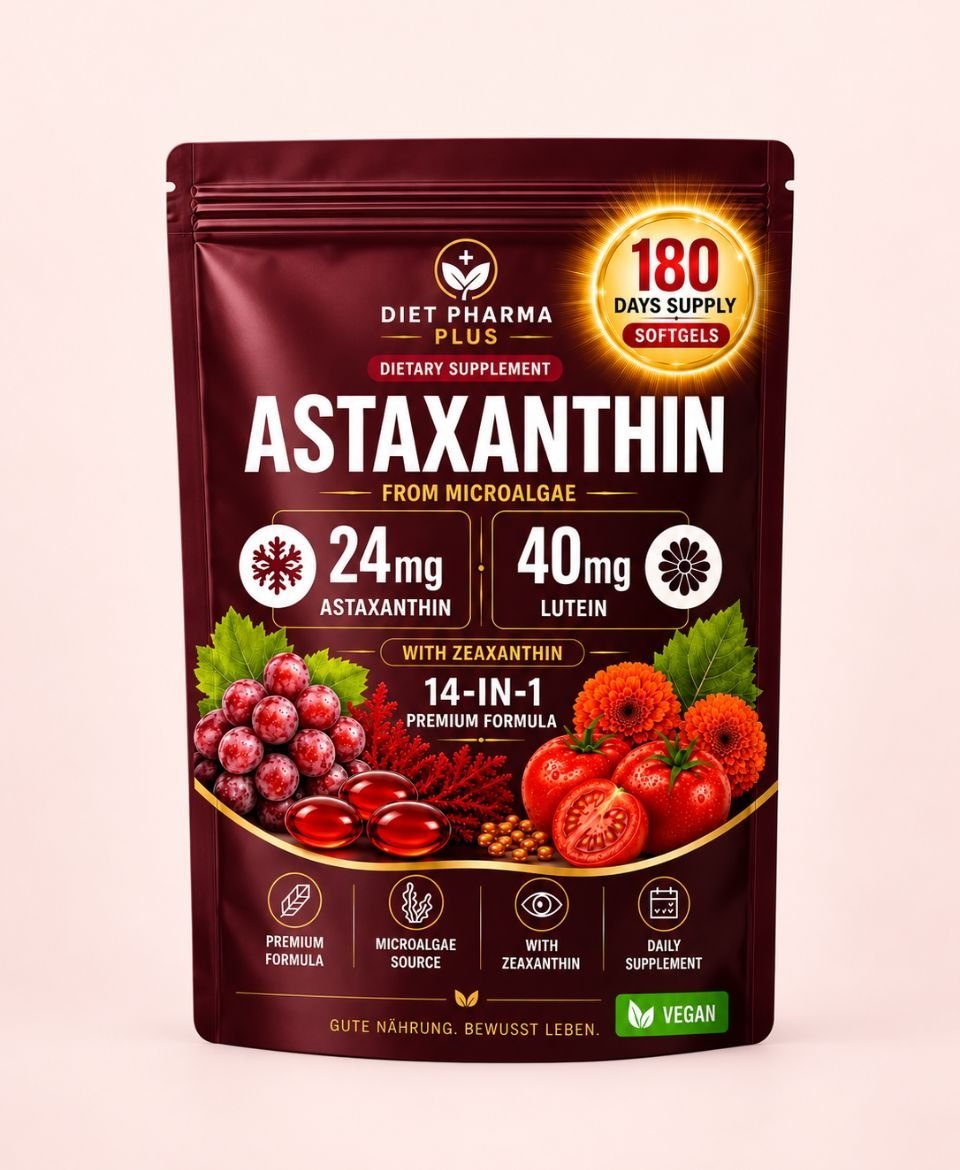
What does an astaxanthin label actually tell you? This guide explains origin, serving information and combination formulas without promising health outcomes.
Our comparisons use published Diet Pharma Plus product information. Check the complete label for ingredients, serving size and warnings before purchase.
Origin and terminology
Astaxanthin is a carotenoid. Supplement labels often identify Haematococcus pluvialis microalgae as its source. The algae name, raw-material description and stated astaxanthin quantity provide different information. Origin alone does not describe the complete formulation or the permitted daily serving. Compare these details together with the product format, such as softgels.
Milligrams: per unit or per day?
A number on the front may refer to one softgel, several softgels or another basis. Record the amount per unit, the number of units in the daily serving and the resulting daily total. A larger number does not establish quality or recommend a higher intake. Raw-material weight and astaxanthin weight are not automatically the same.
EU conditions and daily servings
Astaxanthin-rich oleoresin from Haematococcus pluvialis has specific EU novel-food conditions. The reviewed authorisation provides a maximum of 8 mg astaxanthin daily for people over 14, with separate age-group and warning requirements. A marketing number should not be treated as intake directions. We are verifying the published quantity of our listed combination formula before making it orderable here.
Lutein, zeaxanthin and other constituents
Combination products may include other carotenoids, vitamins, minerals or botanical ingredients. A label such as “14-in-1” counts selected constituents; it does not establish equivalence or a shared health outcome. Compare each ingredient and its own amount. Check overlap with other supplements. The full ingredient list also identifies softgel shells, carrier oils, additives and possible allergens.
Storage and checking the product
Follow the storage directions on the actual pack and close the container after use. Keep the label, batch reference and best-before date with the product. For composition questions, the batch is more useful than a generic photograph. A testing statement needs a clear scope and product reference; it does not establish a general health outcome.
Pre-purchase checklist
Check origin, raw material, daily quantity, intended age group and warnings. Read full ingredient and allergen labelling. Compare pack contents and servings on the same basis. Ask about unclear dosage before buying. Seek individual professional advice if pregnant, breastfeeding, taking medicines or living with a condition. This article explains labels and does not prescribe intake or promise product effects.
Do not exceed the recommended daily intake. Food supplements are not a substitute for a varied, balanced diet and a healthy lifestyle. Keep out of the reach of young children.
If pregnant, breastfeeding, taking medication, living with a medical condition or unsure, seek medical or pharmaceutical advice before use.